

Packaging lines operate most efficiently when product flow remains stable, even during temporary downstream slowdowns or equipment interruptions. Carton accumulation is a material handling strategy used to create a controlled product buffer between production processes, helping maintain throughput while reducing unnecessary stops throughout the line.
Unlike a specific type of equipment, carton accumulation refers to the process of temporarily storing cartons in a controlled manner before they continue to downstream operations such as case packing, palletizing, inspection, or additional packaging stages. The appropriate accumulation method depends on factors including product characteristics, available floor space, production speed, and the overall layout of the packaging line.
Whether handling folding cartons, corrugated cartons, or other packaged products, a properly engineered accumulation solution helps improve production continuity while supporting efficient product movement throughout the manufacturing process. Depending on the application, manufacturers may choose vertical or in-line accumulation strategies, each offering distinct advantages based on operational requirements.
This guide explains the fundamentals of carton accumulation, common applications, key engineering considerations, and the factors involved in selecting the most appropriate accumulation approach for your production environment.
Carton accumulation is the controlled buffering of cartons between processing or packaging equipment to maintain continuous product flow throughout a production line. Rather than allowing upstream equipment to stop every time downstream machinery slows or pauses, accumulation systems temporarily store products until normal production resumes.
In many packaging operations, accumulation is positioned between equipment operating at different speeds or between machines that may experience brief interruptions during normal production. By absorbing these variations in product flow, accumulation systems help stabilize the line while reducing repeated starts and stops that can affect overall efficiency.
Carton accumulation is commonly used with a wide variety of packaged products, including folding cartons, corrugated cartons, retail-ready packaging, and other secondary packaged goods. The most suitable accumulation method depends on product dimensions, throughput requirements, available floor space, and integration with surrounding equipment.
Rather than being a single equipment design, carton accumulation can be achieved using different system configurations based on the application’s operational requirements. Vertical accumulation systems are often selected where floor space is limited and higher buffer capacity is required within a compact footprint, while in-line accumulation systems are commonly used where additional conveyor length is available.
Modern packaging lines are designed around continuous production. However, temporary interruptions caused by downstream equipment, product changeovers, or routine operational adjustments can quickly affect upstream machinery if adequate buffering is not available.
Carton accumulation helps maintain a more consistent product flow by temporarily holding cartons during these events and releasing them back into the production line as downstream capacity becomes available. This buffering capability can help improve overall equipment utilization while reducing unnecessary line interruptions.
Beyond maintaining throughput, properly engineered accumulation systems contribute to smoother line operation by:
Because every production environment is different, accumulation systems should be engineered around the specific application rather than a standard configuration. Product characteristics, line speed, accumulation capacity, equipment layout, and future production requirements all influence the most appropriate accumulation strategy.
Carton accumulation is typically incorporated at locations where temporary buffering can improve overall production stability. Rather than serving as a standalone process, accumulation systems are integrated into the broader packaging line to balance product flow between upstream and downstream equipment.
Common applications include buffering cartons after cartoning operations, before case packing equipment, ahead of palletizing systems, or between automated packaging processes operating at different production rates. By creating a controlled reserve of product, accumulation systems help absorb normal fluctuations in line performance without unnecessarily interrupting upstream production.
The specific placement of an accumulation system depends on the production process, available floor space, throughput objectives, and the interaction between surrounding equipment. During system design, engineers evaluate the complete production line to determine where accumulation capacity will provide the greatest operational benefit while maintaining efficient product movement.
There is no single accumulation method that is ideal for every packaging line. The appropriate solution depends on available floor space, required accumulation capacity, production throughput, product characteristics, and the layout of surrounding equipment. Two of the most common approaches are vertical accumulation and in-line accumulation, each designed to address different operational challenges. Some lightweight-product lines instead rely on an air-supported conveyance method, where controlled airflow accumulates cartons without a moving belt or chain beneath them.
Vertical accumulation systems store products by utilizing vertical space rather than extending the conveyor footprint across the production floor. This approach is particularly beneficial in facilities where floor space is limited or where higher accumulation capacity is required within a compact layout.
Vertical systems are commonly used to buffer cartons ahead of downstream equipment such as case packers, palletizers, or other packaging processes while helping maintain continuous product flow during temporary production interruptions.
For more information about vertical accumulation applications, explore Dillin’s Vertical Accumulation Systems.
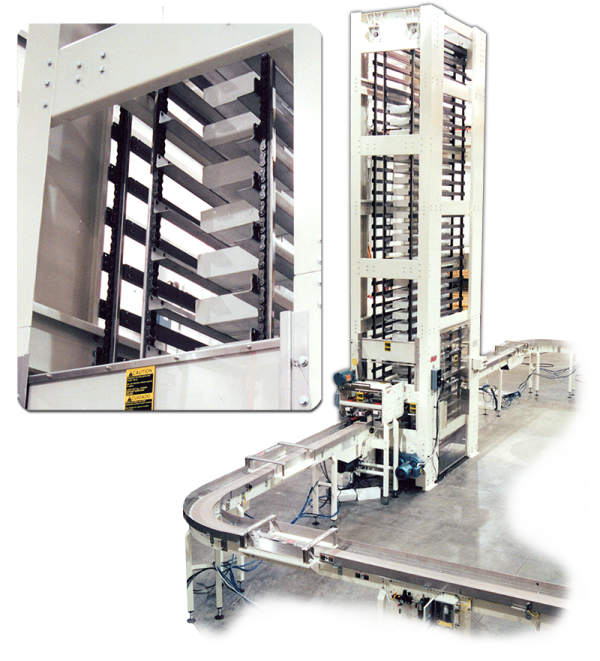
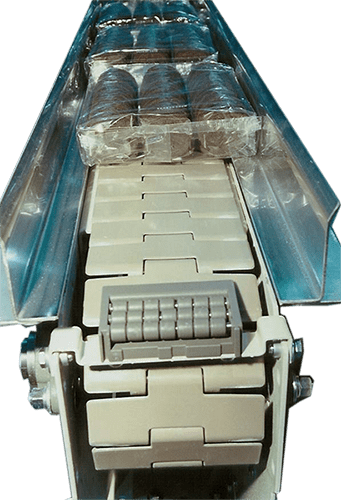
In-line accumulation systems buffer products along a horizontal conveyor path. They are often selected when adequate floor space is available and the production layout allows additional conveyor length.
Because products remain on a continuous conveyor path, in-line systems can provide a straightforward solution for applications requiring moderate accumulation capacity while maintaining smooth product movement between processing stages.
Learn more about Dillin’s In-Line Accumulation Systems and their applications.
| Consideration | Vertical Accumulation | In-Line Accumulation |
|---|---|---|
| Primary Space Requirement | Uses vertical space | Uses horizontal floor space |
| Floor Space Utilization | Excellent for compact layouts | Requires a longer conveyor footprint |
| Typical Accumulation Capacity | Higher capacity within a compact footprint | Varies depending on conveyor length |
| Production Layouts | Ideal where floor space is limited | Ideal where floor space is readily available |
| System Selection | Selected based on application requirements | Selected based on application requirements |
Carton dimensions, weight, and overall rigidity influence how products move through an accumulation system. Folding cartons, corrugated cartons, and other packaged products may behave differently depending on their construction, making proper system selection important for maintaining stable product flow.
The required line speed directly affects accumulation capacity and system configuration. Higher production rates generally require greater buffering capacity to accommodate temporary downstream interruptions while maintaining consistent upstream production.
The amount of product that must be temporarily buffered depends on the production process and operational objectives. Engineers evaluate expected downtime events, production rates, and recovery requirements to determine the appropriate accumulation capacity for the application.
Facility layout often plays a significant role in system selection. Where floor space is limited, vertical accumulation may provide greater buffering capacity within a smaller footprint. In facilities with additional conveyor space, in-line accumulation may offer an effective alternative.
Accumulation systems rarely operate independently. They are typically integrated with conveyors, cartoners, case packers, palletizers, inspection equipment, and control systems. Proper integration helps maintain smooth product movement throughout the packaging line while minimizing unnecessary production interruptions.
Production requirements often change over time. Anticipating future throughput increases, new product formats, or equipment upgrades during the design phase can help improve long-term system flexibility and reduce the need for significant modifications later.
No two packaging lines operate under exactly the same conditions. Product characteristics, production rates, available floor space, equipment layout, and future expansion plans all influence the most appropriate accumulation strategy.
Rather than selecting a standard configuration, accumulation systems are typically engineered around the specific requirements of each production environment. At Dillin, our engineering team evaluates the complete packaging line—including product flow, downstream equipment, controls integration, and operational objectives—to develop accumulation solutions that support reliable, efficient production today while providing flexibility for future growth.
Carton accumulation provides temporary product buffering between production processes to help maintain continuous product flow during downstream slowdowns or brief equipment interruptions. Properly engineered accumulation systems help stabilize packaging lines while reducing unnecessary starts and stops of upstream equipment.
Depending on the application and system design, accumulation solutions can be configured to handle folding cartons, corrugated cartons, retail-ready packaging, and other packaged products. Factors such as carton dimensions, weight, rigidity, and production speed all influence the most appropriate accumulation approach.
Accumulation capacity is typically based on production throughput, expected downtime events, recovery requirements, product dimensions, and overall line objectives. The appropriate capacity should be determined as part of the complete packaging line design rather than as an isolated calculation.
Yes. Accumulation systems are commonly integrated with existing conveyors, cartoners, case packers, palletizers, inspection equipment, and plant control systems. Successful integration requires evaluating the entire production line to ensure smooth product flow and reliable operation.
Performance is influenced by multiple factors, including carton size and construction, production speed, accumulation capacity, conveyor layout, controls integration, and the interaction between upstream and downstream equipment. Evaluating these factors together helps ensure the accumulation system supports long-term production efficiency.
While many accumulation technologies share common design principles, system configuration is typically engineered around the specific application. Product characteristics, production goals, facility layout, and operational requirements all influence the final system design.