

Understand how table top conveyors operate, their key components, common applications, and the factors that influence system selection.
A table top conveyor is a chain-driven conveying system that uses a continuous series of flat, interlocking plates to create a stable surface for moving products through production and packaging lines. Products ride directly on the conveying surface while guide rails help maintain their position and orientation as they travel along the conveyor.
Table top conveyors are particularly useful when products require controlled movement through straight sections, curves, transfers, or accumulation areas. Their modular construction also allows conveyor layouts to be adapted to different product-handling and production requirements.
For Dillin-specific system configurations and available specifications, see our Table Top Conveyor Systems page.
Table top conveyors use a continuous chain made up of interconnected flat-top links that travel along the conveyor frame. The chain is driven by sprockets, creating a moving surface that carries products from one point in the production line to another. Wear strips between the chain and frame help support smooth chain travel and reduce direct contact with the conveyor structure.
Several components work together to control product movement:
Together, these components create a continuous conveying path that can move products through straight runs, curves, transfers, and other stages of a production or packaging process.
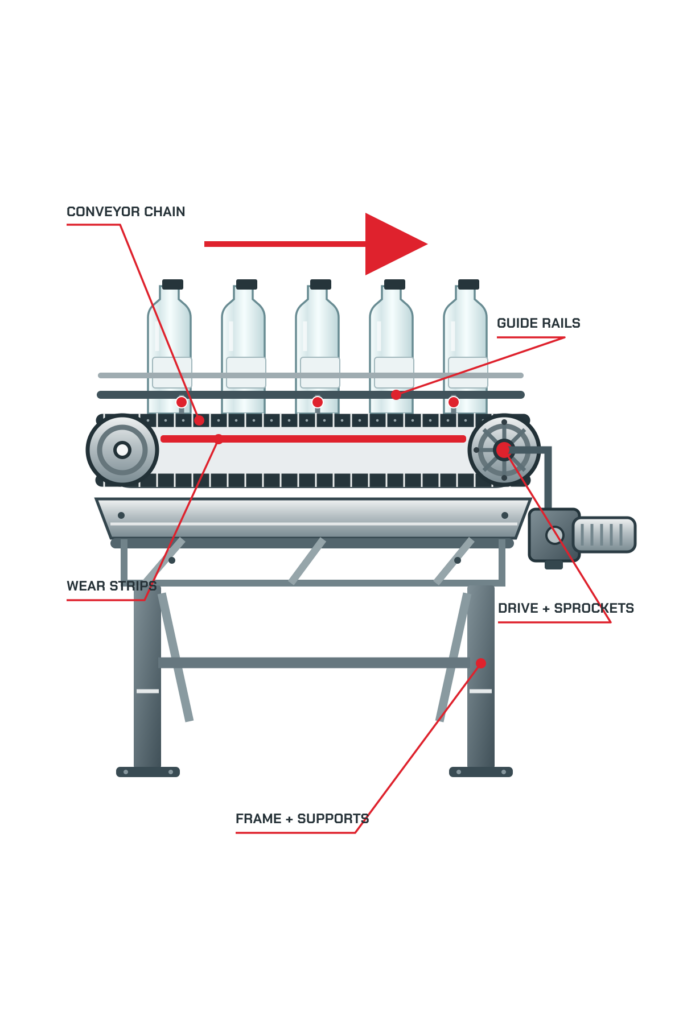
The conveyor chain plays a major role in how a table top system performs. Chain material should be selected around the products being conveyed, operating conditions, required durability, friction characteristics, and cleaning or sanitation requirements.
Plastic table top chains are commonly used where smooth product handling, relatively low friction, and corrosion resistance are important. Their lighter construction can make them suitable for many packaging and general product-handling applications.
Stainless steel chains may be preferred for applications involving demanding operating conditions, elevated temperatures, frequent cleaning, or environments where additional durability and corrosion resistance are required.
Material selection should not be considered in isolation. Product weight and stability, conveyor speed, curves, operating environment, and maintenance requirements can all influence the appropriate chain and conveyor configuration.
Table top conveyors are commonly used in production and packaging environments where products need to remain stable, controlled, and consistently positioned as they move between processes. Their compact conveying surface and ability to accommodate different layouts make them useful for both straightforward transfers and more complex product-flow requirements.

Moving bottles, containers, and packaged products through filling, labeling, inspection, packing, and other stages of a production line.
Conveying containers and packaged products where controlled movement and appropriate conveyor construction are important considerations.
Handling bottles, jars, and other containers through filling, labeling, packaging, and related production processes.
Transporting packaged goods and other stable products between processing, assembly, inspection, and packaging operations.
The suitability of a table top conveyor ultimately depends on the product characteristics, required throughput, line layout, and operating environment, rather than the industry alone.
Different conveyor technologies suit different product characteristics and production requirements. The comparison below provides a general guide to where each type tends to fit.
Choosing the right table top conveyor starts with understanding the product and how it needs to move through the production line. Conveyor width or speed alone does not determine the right system; several operating and layout factors need to be considered together.
Product Characteristics
Consider the product’s dimensions, weight, shape, base stability, and required orientation. These factors influence the conveying surface, guide rail arrangement, and overall system design.
Throughput & Conveyor Speed
Required production rates help determine appropriate operating speeds and how products need to enter, travel through, and discharge from the conveyor.
Line Layout & Available Space
Straight runs, curves, transfers, elevation requirements, and available floor space all influence the most practical conveyor configuration.
Operating Environment
Temperature, moisture, cleaning requirements, and other environmental conditions can affect the appropriate chain material and conveyor construction.
Transfers & Equipment Interfaces
Consider how products will move onto and off the conveyor and how the system will interact with upstream and downstream production equipment.
Maintenance & Accessibility
Component access, routine cleaning, wear components, and ongoing maintenance requirements should also be considered when planning the system.
For actual Dillin chain widths, construction options, layouts, and available configurations, see our Table Top Conveyor Systems page.
Yes. Table top conveyor systems can be designed with curved sections when the chain and conveyor configuration support side-flexing movement. This allows products to change direction while remaining on the same conveying system.
Table top conveyors are commonly used for bottles, containers, cartons, packaged goods, and other products that benefit from a stable conveying surface and controlled positioning. Product size, weight, shape, and base stability all affect suitability.
Plastic chains are commonly selected for smooth handling, lower friction, and corrosion resistance, while stainless steel may suit applications requiring greater durability or more demanding operating conditions. The appropriate material depends on the product, environment, and system requirements.
Yes. Table top conveyor systems can support accumulation applications, although the appropriate configuration depends on the product, required accumulation behavior, line speed, and surrounding equipment.
Start with the product characteristics, required throughput, line layout, operating environment, transfers, and equipment interfaces. These factors help determine the appropriate chain, conveyor dimensions, layout, speed, and other system requirements.
If you’d like an engineer’s assessment, layout recommendations, or a custom quote, Dillin’s applications team can review your product dimensions, throughput targets, and plant layout to specify the exact table top conveyor configuration for your project. Contact Dillin at 419-969-6063 or use the contact form on the product page.